Subvastus Knee Replacement
Preserving the Quadriceps, Supporting Early Recovery
The quadriceps muscle plays a fundamental role in knee function, allowing us to stand, walk, climb stairs and regain independence following knee replacement surgery. Preserving this important muscle mechanism is a central part of my surgical philosophy.
I have completed further subspecialty fellowship training in knee, hip and shoulder replacement surgery, with a particular focus on muscle-sparing techniques, including the subvastus approach to total knee replacement.
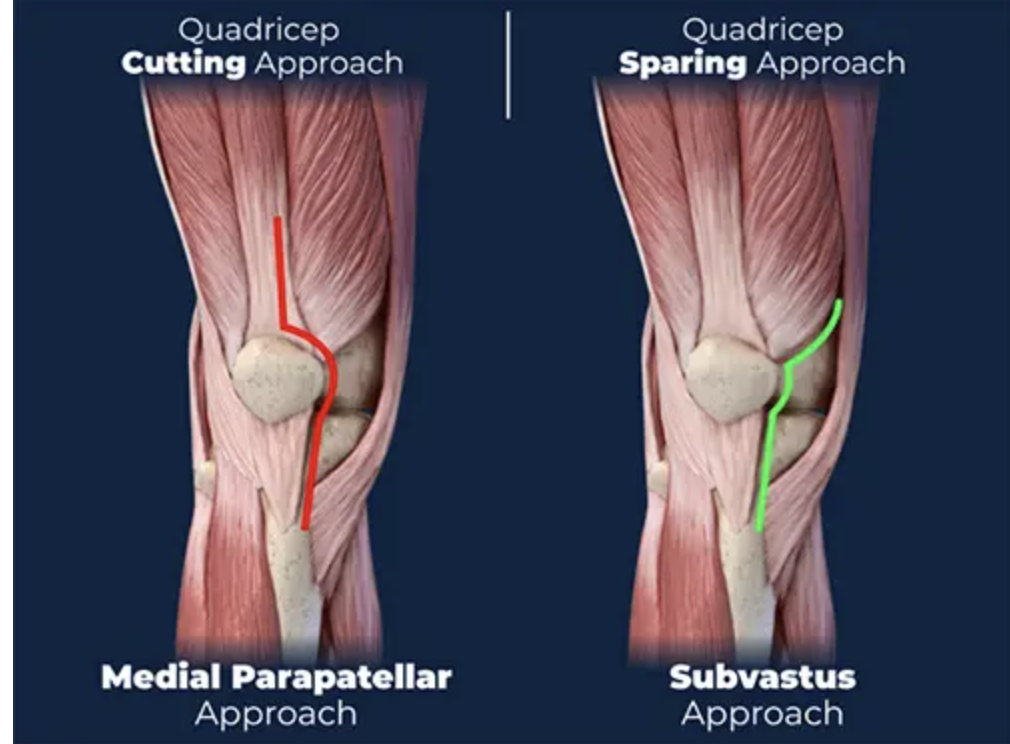
In my practice, I routinely perform primary total knee replacements using the subvastus approach, which allows me to access the knee joint without cutting through the quadriceps tendon or splitting the vastus medialis muscle.
This approach is technically more demanding and I can candidly say - it takes me longer to perform than the conventional medial parapatellar approach.
However, this is a conscious choice I make, as I believe preserving the quadriceps mechanism is a worthwhile surgical objective, provided it does not compromise surgical safety or implant positioning.
Some clinical studies suggest that the subvastus approach may offer advantages in early quadriceps recovery, postoperative pain and mobility. However long-term outcomes are generally comparable between established surgical approaches.
My philosophy is to preserve normal anatomy wherever possible, without compromising the quality or safety of the reconstruction.